
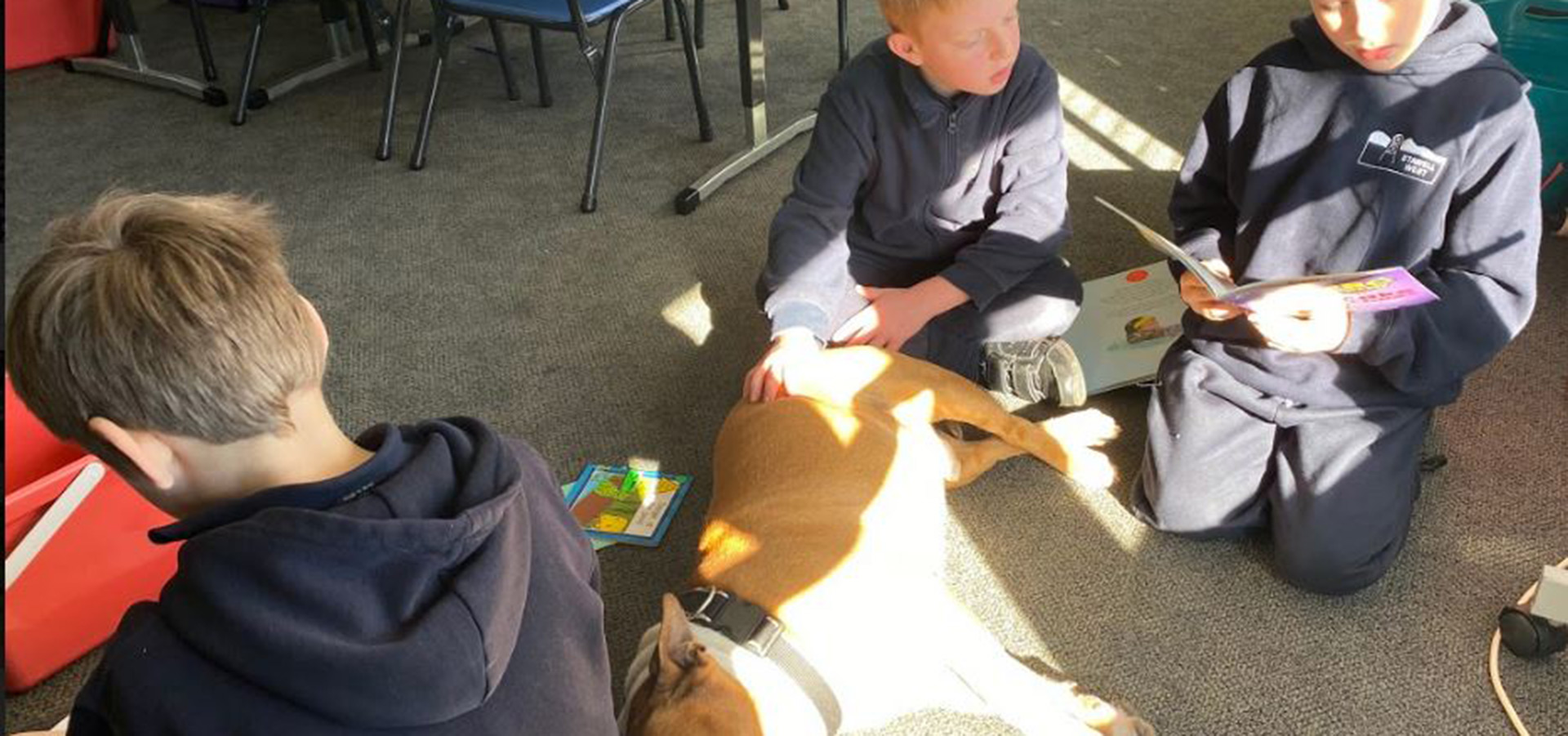
TEACHING & LEARNING
LITERACY
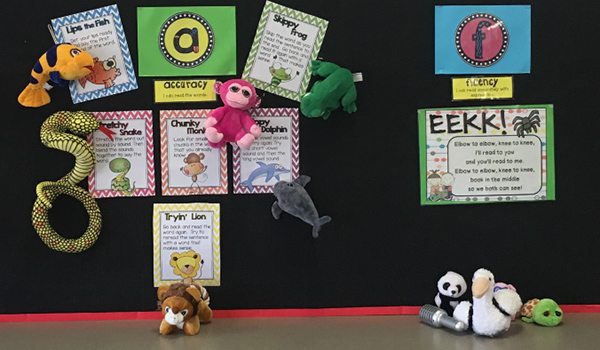
C.A.F.E
CAFE is the organisation of the reading strategies taught during the reading time. CAFE is the acronym for the four major components of reading:
- C for Comprehension
- A for Accuracy
- F for Fluency
- E for Expanding Vocabulary
Your child will learn reading strategies within each component. These strategies will become tools they learn and apply to help them become better readers and writers.
JOLLY PHONICS
Jolly Phonics is a phonics program that teaches children the alphabetic code of English. In the first term of schooling the children are taught the 42 letter sounds, how to blend them to read words, and how to cope with the first few irregular keyword. At this point the children can attempt to read books for themselves.
There are five main elements to the teaching:
1) Learning the Letter Sounds.
The main 42 sounds of English are taught – one sound every day and in the Jolly Phonics order.
- s a t i p n
- c k e h r m d
- g o u l f b
- ai j oa ie ee or
- z w ng v oo oo
- y x ch sh th th
- qu ou oi ue er ar
2) A multisensory method is used to introduce the children to the letter sounds. There is a storyline, action and a sound. By doing an action associated with the sound, e.g., rub tummy and say “mmmmm” for the /m/ sound, the children remember it more easily.
3) Each child has their own ‘Sound Book’. Every day the letter sound taught is stuck into the book and taken home. Parents are asked to help their children learn the sounds by going through the sound book each week.
4) In order to blend efficiently it is important to know the letter sounds fluently. Every day, flash cards are held up for the children so they can call out the sounds and they do the actions.
5) Some sounds, are represented by two letters (digraphs). The children need to recognise digraphs in words, e.g., the ‘ng’ in ‘strong’. The digraphs ‘oo’ and ‘th’ each have two sounds, e.g., ‘book’ and ‘moon’, ‘thin’ and ‘that’. In Jolly Phonics they are initially written in two sizes to help the children understand that there are two sounds.
READING SUPPORT
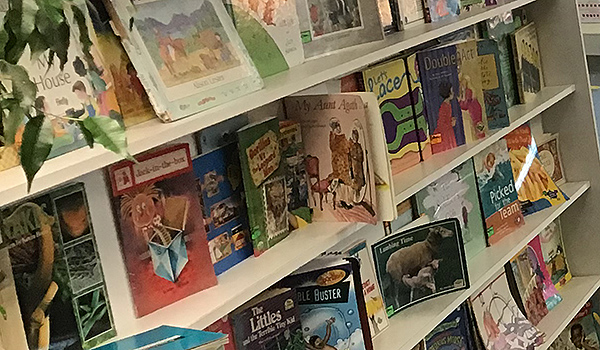
The Fountas & Pinnell Leveled Literacy Intervention System (LLI) is an intensive, small-group, supplementary literacy intervention for students who find reading and writing difficult. The goal of LLI is to lift the literacy achievement of students who are not achieving grade-level expectations in reading. The LLI systems are designed to:
- Advance the literacy learning of students not meeting grade-level expectations in reading
- Deepen and expand comprehension with close reading
- Elevate the expertise of teachers
- Increase reading volume by engaging students in large amounts of successful daily reading
- Increase student engagement with books that build knowledge
- Intervene with small groups of struggling readers to maximize growth
- Meet the needs of struggling readers
- Monitor student progress
SMART SPELLING
All teachers at Stawell West Primary have undergone formal SMART Spelling training. SMART Spelling is a simple, effective and fun way to teach and learn spelling across our school, from Foundation to Year 6.
SMART Spelling incorporates the weekly systematic teaching of spelling as well as the teaching of students’ personal words taken from their writing.
NUMERACY
NUMERACY PROGRAM
Our Numeracy program follows a clear instructional model which is taught throughout the school. It consists of four parts to each lesson; Fluency Activities, Number Talks, Explicit Teaching, and Reflection.
The fluency part of the lesson gives students the opportunity to practise their skills in recalling number facts, skip counting, multiplication tables and knowledge of numbers.
Number talks support students to develop different strategies to solve problems. Sharing these strategies with the class is an important part of cooperative learning.
In the explicit teaching component of the lesson, new concepts are introduced and taught with the aid of support materials. Students are then provided with activities, either in groups or independently so that they can practise that skill.
To conclude the lesson, a reflection time is allowed so that everyone has an opportunity to share their learning, wonderings and ideas.
GET IN TOUCH
Address: 80 - 88 Cooper St, Stawell Vic 3380
Email: stawell.west.ps@edumail.vic.gov.au
Phone: +03 5358 1661
Fax: 03 5358 4330
